
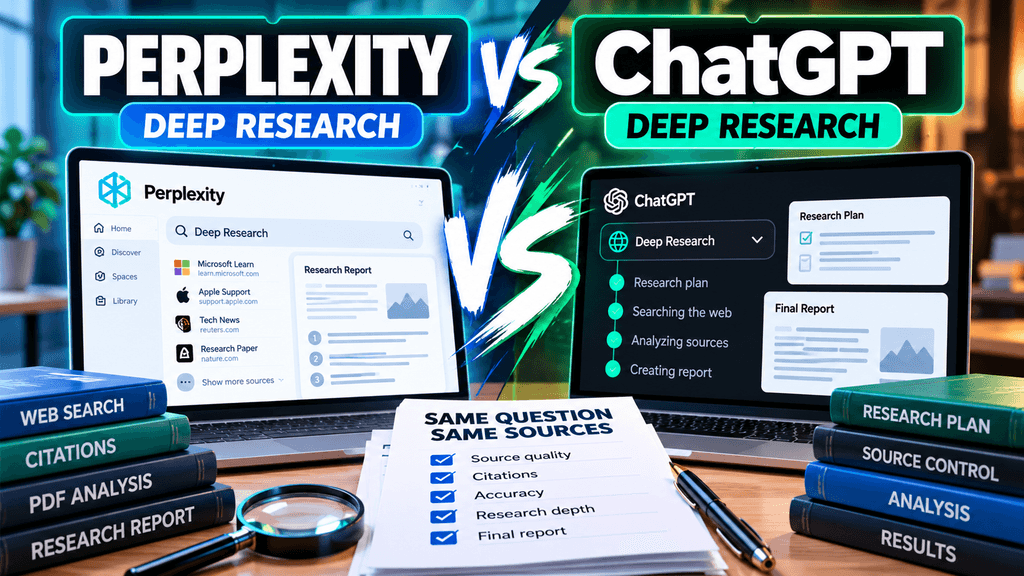
Perplexity and ChatGPT Deep Research can both perform multi-step web research, analyze sources and produce citation-backed reports, but they give users different levels of control. ChatGPT Deep Research is especially strong when you want to define or restrict the sources used and review a research plan before it starts, while Perplexity is built more directly around rapid web discovery, large-scale retrieval and source-heavy research. OpenAI Help Center
For quick research, either tool can be useful.
For serious work, the difference is less about which model is “smarter” and more about how the research process is controlled.
ChatGPT Deep Research vs Perplexity: quick comparison
| Feature | ChatGPT Deep Research | Perplexity Deep Research |
|---|---|---|
| Multi-step research | Yes | Yes |
| Research plan before starting | Yes | Yes |
| Restrict research to specific websites | Yes, directly supported | Source control available, but less central to workflow |
| Uploaded files | Yes | Yes |
| Connected apps/data | Supported apps | Files, apps and premium sources |
| Citations | Yes | Yes |
| Live progress | Yes | Yes |
| Interrupt and redirect research | Yes | Available within Computer workflows |
| Primary-source discovery | Strong | Strong |
| Search-first experience | Good | Excellent |
| Final structured report | Yes | Yes |
| Premium data sources | Depends on connected services | Statista, PitchBook, CB Insights and others on eligible plans |
The biggest practical difference is that ChatGPT emphasizes research steering, while Perplexity emphasizes search depth and retrieval. OpenAI Help Center
Where ChatGPT Deep Research has an advantage
ChatGPT Deep Research lets you review and modify the research plan before the task begins.
You can also specify websites or domains and choose between:
- searching only those sites, or
- prioritizing those sites while still allowing broader web search. OpenAI Help Center
That is extremely useful for technical research.
Imagine you are investigating an Intune problem.
Instead of allowing the system to pull information from random blogs, you could tell it:
Use only Microsoft Learn, Apple Support and Microsoft Tech Community.
That makes the research easier to verify and reduces the chance that a weak third-party article becomes the basis for an important claim.
ChatGPT also allows you to interrupt the research while it is running and change the scope or sources. OpenAI Help Center
For investigative work, that level of control matters.
Where Perplexity Deep Research has an advantage
Perplexity is built much more directly around search.
Its current Deep Research system uses its Agent Search architecture to perform large numbers of retrieval steps and search across many websites in parallel. Perplexity says the system can find primary sources across hundreds of sites and cite its findings. Perplexity AI
That makes it particularly attractive when your first question is:
“What information exists about this topic?”
rather than:
“I already know which sources I trust — analyze them for me.”
Perplexity can also combine:
- live web sources
- uploaded files
- connected apps
- premium databases
and cross-reference them in one research workflow. Perplexity AI
Eligible Perplexity plans can also access premium sources such as Statista, PitchBook and CB Insights, which can be useful for market and company research. Perplexity AI
Which is better for citations?
Both tools are designed around citation-backed research.
ChatGPT Deep Research produces a structured report with source links and a dedicated sources section. OpenAI also lets you inspect the activity history showing how the research progressed. OpenAI Help Center
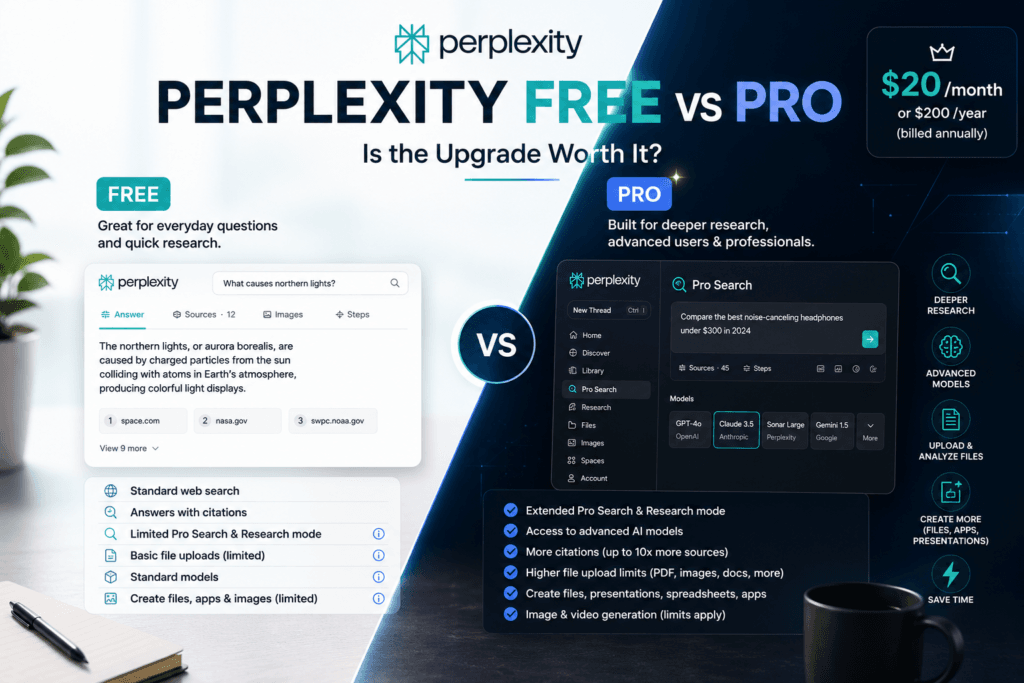
Perplexity has made citations part of its core product since the beginning. Its current Pro plan advertises significantly more citations per answer than the free tier. Perplexity AI
But citation quantity alone is not enough.
A better research test is:
- Did the citation actually support the claim?
- Was it a primary source?
- Was the source current?
- Did the tool ignore contradictory evidence?
- Did it cite a secondary article when an official document was available?
That is where an original TechJournalAI test could add real value.
Which is better when using the same sources?
This is where ChatGPT has a particularly useful feature.
Its Deep Research interface explicitly allows users to restrict research to specified domains. OpenAI Help Center
That makes it easier to create a controlled comparison.
For example, both tools could be asked to research the same question while using:
learn.microsoft.comsupport.apple.comsupport.google.com
If both are using roughly the same source pool, differences in the final answer become more meaningful.
You can then compare:
- Which tool identifies the most relevant documents
- Which notices conflicting evidence
- Which separates confirmed facts from assumptions
- Which provides the clearest final explanation
- Which cites every important claim
Without controlling the sources, one tool might simply look better because it found a completely different set of pages.
Which is better for uploaded files?
Both can combine files with web research.
ChatGPT Deep Research supports uploaded files by default and can combine them with public web information and supported connected sources. OpenAI Help Center
Perplexity also says its Deep Research workflows can read your files and connected apps before cross-referencing them against live web sources. Perplexity AI
For example, you could upload:
- a technical PDF
- an annual report
- a policy document
- an error log
and ask the tool to verify the document against current information online.
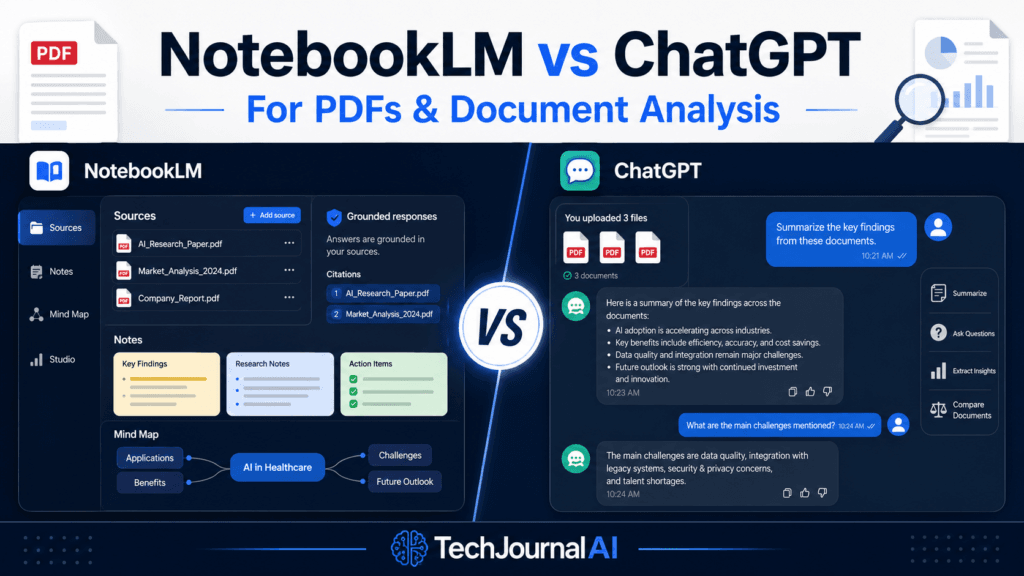
For pure document analysis, other tools may sometimes be better.
But for document + live-web verification, both are strong.
Which is faster?
This depends heavily on the question.
OpenAI says Deep Research is intended for complex work rather than quick lookups and may take substantially longer than normal web search. OpenAI
Perplexity also separates ordinary search from Deep Research, with Deep Research designed for more complex investigations rather than simple queries. Perplexity AI
If you only need:
“What is the current Gemini file upload limit?”
neither tool needs a full Deep Research workflow.
Use normal search.
Deep Research makes sense for questions like:
“Compare all currently documented Gemini upload limits across free and paid plans, identify recent changes, and reconcile conflicting Google documentation.”
What about price?
Perplexity currently offers a free plan and a Pro plan at $20 per month, with Pro including Deep Research and higher usage limits. Perplexity AI
ChatGPT Deep Research availability depends on the ChatGPT plan and account. OpenAI says usage limits vary by plan, with the remaining allowance shown directly in the product. OpenAI Help Center
That makes Perplexity easier to describe in simple pricing terms.
ChatGPT’s value depends more on whether you already use the rest of ChatGPT for writing, coding, files and general work.
Which one should you use?
Choose ChatGPT Deep Research if you care most about:
- Controlling which websites are used
- Reviewing the research plan first
- Steering the research while it runs
- Combining research with files and other ChatGPT workflows
- Producing a structured report afterward
Choose Perplexity Deep Research if you care most about:
- Fast source discovery
- Broad live-web research
- Search-heavy workflows
- Large numbers of citations
- Premium market and business sources
- Moving quickly from search to research
For important research, the best workflow may actually be to use both.
Use Perplexity to discover strong sources.
Then use ChatGPT Deep Research with a restricted source list to analyze those sources more carefully.
Bottom line
Perplexity is more strongly optimized around discovering and retrieving information from the web, while ChatGPT gives users unusually direct control over the research plan and which websites can be used. OpenAI Help Center
For quick discovery, Perplexity may feel more natural.
For controlled research where the quality and origin of sources matter, ChatGPT Deep Research has a particularly useful advantage.
But the most important comparison still needs to be done:
Give both tools the same question, the same source restrictions and the same success criteria.
That is the version of this article that could become genuinely original TechJournalAI content rather than another generic AI comparison.
Sources
- OpenAI — Deep Research in ChatGPT
OpenAI Deep Research documentation - OpenAI — Research with ChatGPT
OpenAI research guide - Perplexity — Deep Research
Perplexity Deep Research - Perplexity — Pro plan
Perplexity Pro documentation

Pingback: What Is OpenAI Dots? The Always-On AI Agent Explained