
Yes, ChatGPT can analyze an exported Google Search Console
spreadsheet and identify useful SEO opportunities. In my test, it
correctly found pages gaining impressions, separated promising rankings
from weak signals and identified old URLs that still appeared in Google.
However, it could not replace Search Console, keyword research software
or human knowledge about which clicks were genuine.
I tested the workflow using real performance data from TechJournalAI,
a young technology website. The result was useful—but only after I gave
ChatGPT an important piece of context that the spreadsheet did not
contain.
Why I Tested
ChatGPT Work With Search Console Data
OpenAI is positioning ChatGPT Work as a system for multi-step
research and professional files rather than simple question answering.
Its documentation says Work can use files and tools to create
spreadsheets, analyses and other finished outputs. OpenAI also
recommends GPT-6 Astra for demanding work requiring careful reasoning or
polished files, although availability depends on the account and model
selector.
That creates a practical SEO question: can ChatGPT examine a Search
Console export and tell a website owner what to do next?
This is more difficult than summarizing a spreadsheet. Search Console
data includes different aggregation methods, hidden queries, low-volume
noise and metrics that can easily be misinterpreted.
The Test Setup
I exported the last three months of Google Search performance as an
Excel workbook. Because the website only began collecting meaningful
data in July, the daily sheet contained results from July 12 through
September 2, 2026.
The workbook contained separate sheets for:
- Daily performance
- Search queries
- Pages
- Countries
- Devices
- Search appearance
- Applied filters
I used the following instruction:
Analyze this Google Search Console export for a young
English-language technology website. Treat all clicks as unreliable
because the site owner generated many of them. Base the main conclusions
on impressions, average position and page-level patterns. Separate facts
from hypotheses, identify the strongest content opportunities and flag
technical issues.
That sentence about the clicks changed the quality of the result.
Without it, an AI system could interpret the website’s 23 recorded
clicks as organic audience growth. Most of those clicks came from the
owner checking the website in Google, so they were not useful evidence
of real demand.
What ChatGPT Found in the
Export
The property recorded 150 impressions during the available period.
Germany generated 53 impressions, the United States 24 and the United
Kingdom seven. Those three markets represented 84 impressions
combined.
Clicks and click-through rates were excluded from the main
evaluation. The most useful article-level signals were:
| Page | Impressions | Average position | Practical interpretation |
|---|---|---|---|
| How to Use NotebookLM With PDFs | 42 | 17.83 | Strongest opportunity to move toward page one |
| NotebookLM vs ChatGPT for PDFs | 20 | 9.55 | Already appearing around the first-page boundary |
| Gemini File Upload Failed | 10 | 3.40 | Very small sample, but the problem-driven keyword is gaining visibility |
| Why Your Phone Battery Drains Overnight | 5 | 8.40 | Early page-one signal that needs more impressions |
| Claude Code for Beginners | 6 | 59.67 | Indexed, but not yet competitive |
The clearest recommendation was not “publish more AI news.” It was to
strengthen the NotebookLM cluster. The practical PDF guide had the most
impressions among individual articles, while the NotebookLM comparison
was already close to the first page on average.
The Gemini upload article also supported a broader pattern: specific
troubleshooting content can gain visibility faster than broad
informational posts on a new domain.
A Technical Problem
the Analysis Exposed
The export contained several old placeholder URLs with titles based
on Lorem Ipsum text. They had only one or two impressions each, but they
should not have been competing for Google’s attention at all.
That led to a concrete technical action: confirm that the deleted
pages return the correct status or redirect them to genuinely relevant
replacements. Requesting temporary removal in Search Console is not a
permanent fix if the URLs remain accessible or internally linked.
This was one of the most useful results because it connected content
analysis with index cleanup rather than producing another generic list
of keywords.
What ChatGPT Did Well
ChatGPT Work handled the multi-sheet Excel file without requiring the
data to be copied into a prompt. It also followed the instruction to
discount clicks and based its recommendations on the remaining
evidence.
The strongest parts of the analysis were:
- Prioritisation: It identified the pages with enough
impressions to deserve attention first. - Pattern recognition: It noticed that
troubleshooting and comparison pages were producing stronger early
signals. - Market segmentation: It separated Germany, the US
and the UK instead of treating all traffic as one audience. - Technical detection: It flagged obsolete
placeholder URLs that were still appearing in search data. - Cautious conclusions: It treated rankings based on
one or two impressions as weak signals rather than proof of
success.
This is the kind of multi-step file analysis OpenAI describes for
ChatGPT Work. If GPT-6 Astra is selected and available in the account,
OpenAI presents it as the preferred model for demanding reasoning and
professional file tasks. This test should not be treated as an
Astra-versus-other-model benchmark, however, because the exported
analysis did not provide an auditable model identifier.
If Astra does not appear in your account, see our guide explaining why
GPT-6 Astra may not be showing in ChatGPT.
Where the Analysis Could
Mislead You
ChatGPT cannot recover data Google did not include. Google explains
that some low-volume searches are anonymized for privacy and remain part
of chart totals even though they do not appear in the query table. In
this export, only five query rows were visible despite 150 total
impressions.
It also cannot obtain reliable keyword volume, backlink strength or
competitor authority from the spreadsheet alone. Those questions require
additional live research or specialist SEO data.
Average position needs careful treatment as well. A position of three
based on ten impressions is interesting, but it is not stable evidence
that a page ranks third for a valuable keyword across every country and
device.
Finally, page totals and property totals should not be added together
as though they use identical aggregation. Google documents that chart
data is aggregated by property, while page reports are aggregated by
URL. That can create legitimate differences.
How to Analyze
Your Own Search Console Export
Export the complete Performance report from Search Console as an
Excel file. Then give ChatGPT the business context that the file cannot
reveal.
Your instruction should specify:
- The age and language of the website
- Which countries matter
- Whether branded or owner-generated clicks should be ignored
- Whether you want content, technical SEO or both
- The minimum number of impressions required before drawing a
conclusion - That facts, estimates and hypotheses must be labelled
separately
Do not ask only, “What does this data mean?” A vague instruction
usually produces a vague report.
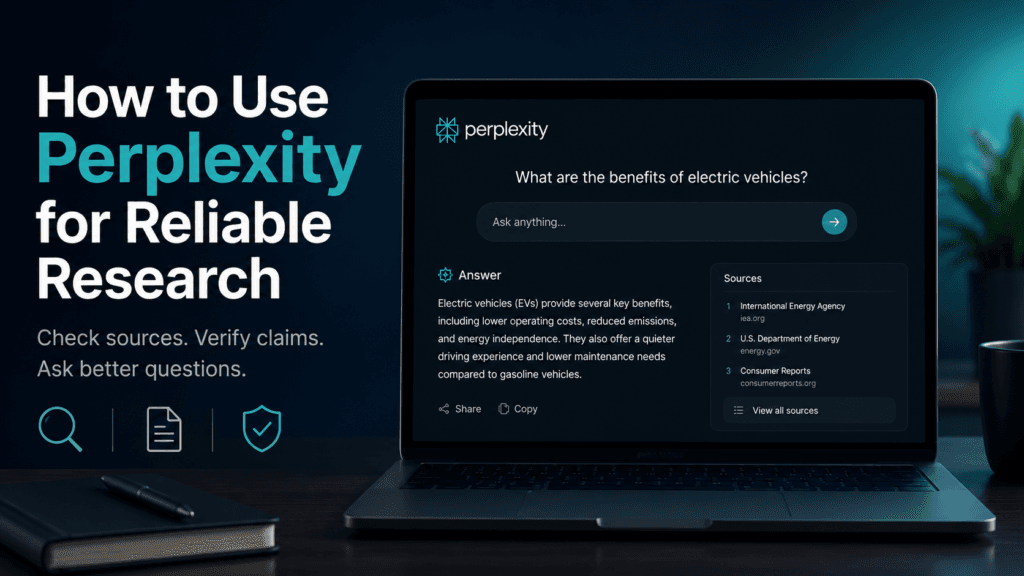
For research workflows beyond Search Console, our guide to using
Perplexity for reliable research explains why source checking still
matters when an AI tool produces a confident answer.
Final Verdict
ChatGPT Work can turn a Search Console export into a useful first SEO
review. It is particularly effective at prioritizing pages, finding
patterns across sheets and converting raw metrics into an action
list.
It is not an automatic SEO strategist. The user still needs to
explain unreliable traffic, understand the site’s history and verify
recommendations against the live search results.
For TechJournalAI, the test produced three defensible actions:
improve the NotebookLM PDF guide, reinforce the NotebookLM comparison
with internal links and clean up obsolete placeholder URLs. That is a
practical result from a small dataset—not a promise that AI can predict
Google’s rankings.
Sources
- OpenAI, ChatGPT Work: https://learn.chatgpt.com/docs/get-started-with-work
- OpenAI, What’s new in ChatGPT and Codex: https://learn.chatgpt.com/docs/whats-new
- Google Search Console Performance report: https://support.google.com/webmasters/answer/7576553
- Google Search Console query dimensions and anonymized data: https://support.google.com/webmasters/answer/17011259
- Google Search Central, using Search Console for SEO: https://developers.google.com/search/docs/monitor-debug/google-analytics-search-console

Pingback: GPT-6 Astra Not Showing in ChatGPT? Here’s Why