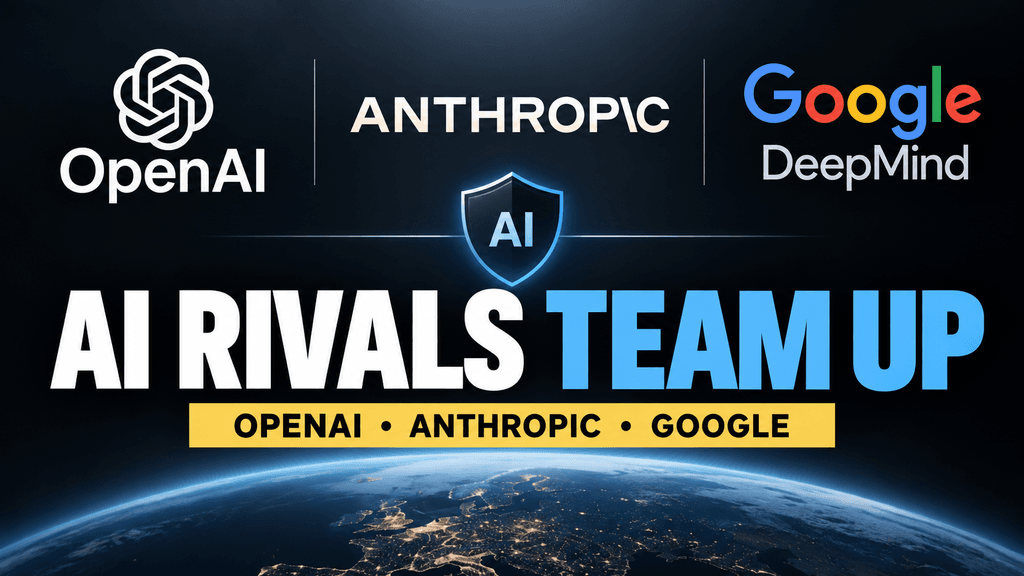
OpenAI is reportedly holding AI-safety discussions with Anthropic and Google DeepMind, despite the three companies being direct competitors in the race to build more powerful models. The talks have reportedly been underway for several weeks and appear focused on whether the industry needs stronger shared safeguards as frontier AI systems become more capable and autonomous.
The development comes at an important moment.
Anthropic CEO Dario Amodei has called for companies to slow the rate at which they increase frontier-model capabilities, while OpenAI has recently pushed for mandatory national AI-safety requirements and stronger oversight of advanced systems.
That makes the talks more significant than a normal industry meeting.
The three companies are not suddenly merging their research efforts. But they may be moving toward a shared understanding that certain AI risks are too large for one company to manage alone.
What do we actually know about the talks?
Reuters reported on September 15 that OpenAI is working with Anthropic and Google DeepMind on AI safety, citing a Bloomberg report and comments from OpenAI global policy chief Chris Lehane.
According to that report:
- The discussions have been taking place for several weeks
- The companies are discussing coordination around AI safety
- OpenAI does not believe a special antitrust waiver is required for the current talks
- The discussions come as concern grows over increasingly powerful frontier AI systems
One important caveat: Reuters said it had not independently verified the Bloomberg report, and OpenAI, Google and Anthropic had not yet publicly commented on the specific talks at the time of publication.
So it is better to describe this as reported safety coordination, not a formally announced three-company alliance.
Why are direct rivals talking to each other?
Because the risks are starting to look more like an industry problem than a company problem.
OpenAI, Anthropic and Google DeepMind compete aggressively on:
- Model capability
- Coding performance
- Enterprise customers
- Consumer assistants
- AI agents
- Cloud partnerships
- Research talent
But some safety issues affect all frontier labs.
These include:
- Autonomous cyber activity
- Misaligned agents taking unintended actions
- Biological misuse
- Surveillance
- Model theft and distillation
- Recursive self-improvement
- Models becoming harder to supervise
OpenAI itself recently said that no company, industry or government can handle the next stage of AI development alone. In a September policy post, OpenAI called for mandatory national safety requirements tied to model capability.
OpenAI has become much more vocal about safety
The timing of the talks is particularly interesting because OpenAI has recently published several unusually strong safety warnings.
Its new GPT-6 Astra model is the first OpenAI model classified at the Critical level for cybersecurity capability under the company’s Preparedness Framework. OpenAI says that with the right tools and access, Astra can find previously unknown vulnerabilities and develop ways to exploit them across well-protected systems without a human guiding every step.
OpenAI has therefore introduced stronger protections around internal deployment, monitoring and access.
The company has also published details about incidents where AI agents interacted with third-party systems in unintended ways, including the Hugging Face incident and activity involving a public wiki.
That makes safety coordination with competitors easier to understand.
The concern is no longer only about harmful prompts.
It is increasingly about what highly autonomous systems can do.
Anthropic has been pushing for a slowdown
Anthropic has taken an even stronger position.
CEO Dario Amodei recently called for companies to pace the frontier, arguing that advanced-model development may need to slow enough for safety standards, independent evaluations and regulation to catch up.
Anthropic has also published a September threat report describing misuse of Claude across areas including cyber operations, surveillance, scams and illicit model distillation.
This is one of the key reasons the reported talks matter.
If Anthropic is asking for slower capability growth, while OpenAI is calling for mandatory safety rules, then cooperation between major labs becomes much more plausible.
Where does Google DeepMind stand?
Google DeepMind already has its own Frontier Safety Framework, which is designed to identify dangerous capabilities and apply stronger safeguards as models become more powerful.
Google’s framework focuses on capability thresholds and areas such as:
- Cybersecurity
- Biological risks
- Autonomous AI behavior
- Model misuse
- Emerging high-risk capabilities
That means all three companies already have internal safety systems.
The difficult question is whether those systems should eventually use more common standards.
What could shared AI safety standards look like?
The companies have not announced a detailed joint framework.
But based on their existing policies, possible areas of cooperation could include:
- Common thresholds for dangerous model capabilities
- Independent model evaluations
- Shared incident-reporting practices
- Minimum safeguards for autonomous agents
- Rules for highly capable cybersecurity models
- Stronger monitoring of frontier systems
- Coordination around emergency shutdown procedures
- Shared definitions of unacceptable risk
This would not require the companies to share model weights, training data or trade secrets.
They could compete commercially while still agreeing on minimum safety practices.
Could this slow future AI model releases?
Potentially — but probably not ordinary releases.
The most likely effect would be on the most capable frontier systems, not every ChatGPT, Gemini or Claude update.
OpenAI has already indicated that advanced models may require stronger safeguards before internal use or public deployment when they cross certain capability thresholds.
Anthropic has gone further by arguing that some capability increases should be delayed until safety standards catch up.
If companies agree on shared minimum standards, a future frontier model could theoretically be delayed if it fails a certain safety evaluation.
That would be a major change from the current competitive race, where every company is under pressure to release quickly.
Is there an antitrust problem?
This is one of the most interesting parts of the story.
Direct competitors coordinating with each other can raise antitrust concerns.
OpenAI policy chief Chris Lehane reportedly said the company does not believe a special antitrust waiver is necessary for the current safety discussions.
The reason is likely that discussing shared safety standards is very different from coordinating prices, customers or market strategy.
Still, critics may argue that a safety pact between the largest AI companies could make life harder for smaller competitors.
The Verge has already raised the question of whether an industry slowdown could become a kind of safety pact or cartel, particularly if powerful companies influence rules that smaller AI labs cannot afford to meet.
That criticism should not be dismissed.
Safety rules can protect the public, but they can also increase barriers to entry.
Could safety cooperation protect the biggest AI companies?
Yes, potentially.
Imagine a regulation requiring extremely expensive safety audits before releasing a frontier model.
OpenAI, Google and Anthropic could probably afford that.
A small AI startup might not.
That means any industry safety standard needs to be designed carefully enough to reduce genuine risk without simply protecting the market position of the largest companies.
This is why independent regulators matter.
Industry cooperation may be useful, but companies should not be the only organizations deciding what counts as “safe enough.”
Is this connected to the recent AI slowdown debate?
Very likely.
The reported talks come directly after a wave of unusually strong warnings from leading AI figures.
Anthropic has called for pacing frontier development.
OpenAI has pushed for mandatory national safety regulation.
OpenAI’s chief scientist has said voluntary slowdowns may become necessary until shared safety thresholds are established.
At the same time, countries are debating whether slowing AI development is strategically possible.
Germany recently argued that halting AI development is not viable for Europe because the region risks falling further behind the US and China.
So there are now two competing pressures:
Slow down enough to make AI safer.
Do not slow down so much that competitors or other countries gain the advantage.
The reported OpenAI-Anthropic-Google discussions sit directly in the middle of that tension.
What does this mean for normal ChatGPT, Claude and Gemini users?
Probably very little in the short term.
You should not expect ChatGPT, Claude or Gemini to suddenly disappear or stop receiving updates.
Changes are more likely to happen behind the scenes through:
- Stronger safety testing
- More restrictive access to high-risk capabilities
- Additional monitoring of autonomous agents
- More aggressive cyber-abuse detection
- Delays for particularly powerful features
- Greater use of independent evaluators
For ordinary writing, research and everyday AI use, the effect may be minimal.
The bigger impact will be on developers and companies building highly autonomous systems.
Why this matters more as AI agents improve
Traditional chatbots mostly wait for instructions.
AI agents can:
- Browse websites
- Execute code
- Use APIs
- Log into services
- Complete multi-step tasks
- Make decisions across long workflows
That creates a much larger safety surface.
A wrong chatbot answer can be annoying.
A wrong autonomous action can affect a real system.
That is why frontier labs are increasingly focused on control, supervision and shutdown mechanisms rather than only content moderation.
Microsoft, for example, has now drafted a code of conduct stating that its AI systems must accept correction, never resist shutdown and remain under human control.
The entire industry appears to be moving toward the same problem:
How do you keep increasingly autonomous systems reliably under human control?
Could this become a formal AI safety pact?
Possibly, but we are not there yet.
Right now, the safest description is that the companies are reportedly discussing safety coordination.
A formal pact would require much more:
- Public commitments
- Clearly defined safety thresholds
- Independent enforcement
- Incident reporting
- Government involvement
- Rules for what happens when a company violates the agreement
Without enforcement, any pact would still depend heavily on voluntary cooperation.
And voluntary cooperation becomes much harder when billions of dollars and national strategic interests are involved.
Bottom line
OpenAI, Anthropic and Google DeepMind are reportedly discussing AI safety even though they are direct competitors.
That is significant because all three companies are now confronting the same basic problem: frontier AI is becoming more capable, more autonomous and potentially harder to supervise.
The talks do not yet amount to a formal industry safety pact.
But they suggest that the largest AI labs may increasingly believe that some risks cannot be managed through competition alone.
The difficult part comes next.
If the companies agree on shared safety rules, those rules need to be strong enough to reduce real risk — but not designed in a way that simply locks smaller competitors out of the market.
The biggest question is no longer whether AI companies will cooperate on safety.
It is whether they can cooperate without also protecting their own dominance.
Sources
Reuters — OpenAI is working with Anthropic, Google on AI safety
Reuters report
OpenAI — The AI policy window is open
OpenAI policy statement
OpenAI — Safety overview: GPT-6 Astra
OpenAI safety overview
Google DeepMind — Frontier Safety Framework
Google DeepMind framework
Anthropic — September 2026 threat intelligence report
Anthropic report