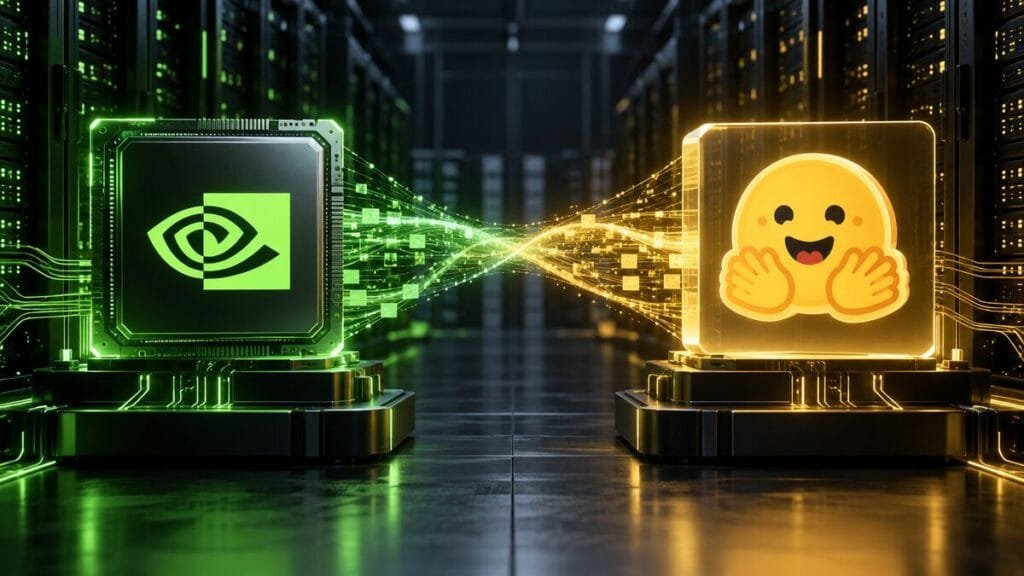
NVIDIA has agreed to acquire Hugging Face for $12.93 billion,
bringing the best-known platform for sharing and deploying open AI
models under the control of the world’s dominant AI-chip company. NVIDIA
says Hugging Face will remain open to different models, frameworks,
cloud providers and computing platforms—and that NVIDIA hardware will
not be required.
That promise answers the first question, but not the most important
one. Developers now need to watch whether Hugging Face remains equally
convenient for AMD, Intel, Google TPU and other hardware after the deal
closes.
What NVIDIA Actually
Announced
NVIDIA CEO Jensen Huang announced the agreement on September 3, 2026.
The exact figure given by the company is $12,930,300,000.
This is an agreement to acquire Hugging Face, not a completed
takeover. The transaction must still move through the normal closing and
regulatory process. Headlines saying NVIDIA has already “bought” Hugging
Face are understandable shorthand, but they skip that distinction.
According to NVIDIA, Hugging Face now serves more than 18 million
developers, researchers and creators. The platform hosts more than 3
million models, 500,000 datasets and 1 million applications, while over
200,000 companies use it to discover, evaluate, customize and deploy
AI.
Those numbers explain why NVIDIA is paying for much more than Hugging
Face’s current revenue. It is buying a central distribution and
collaboration layer for open AI.
Will Hugging Face Still Be
Open?
NVIDIA says yes. Huang stated that developers will continue to choose
their preferred models, frameworks, clouds, inference providers and
computing platforms. He also explicitly said NVIDIA compute will not be
required to build on or deploy through Hugging Face.
That is the strongest public commitment so far. It means there is
currently no announced plan to block rival hardware, remove non-NVIDIA
models or turn Hugging Face into an NVIDIA-only service.
However, “open” is not only about whether competing hardware remains
technically allowed. It also concerns which models receive the most
visibility, which inference options are easiest to activate, how pricing
develops and whether performance work benefits every accelerator
equally.
The real test will therefore come after integration begins—not from
the announcement alone.
Why NVIDIA Wants Hugging
Face
NVIDIA already controls much of the hardware layer used to train and
run advanced AI. Hugging Face gives it a much stronger position at the
developer layer, where people find models, download datasets, test
applications and decide how to deploy them.
The strategic logic is clear:
- Developer access: Hugging Face gives NVIDIA a
direct relationship with millions of AI builders. - Open-model distribution: The platform is one of the
main places where open and open-weight models are released and
discovered. - Deployment influence: Better integration could make
it easier to move a model from a Hugging Face page to NVIDIA
infrastructure. - Competitive protection: Major cloud and AI
companies are developing their own accelerators, reducing their
long-term dependence on NVIDIA GPUs. - Usage intelligence: Platform activity can reveal
which models, frameworks and deployment methods are gaining
adoption.
This does not automatically mean NVIDIA will abuse that position. It
does mean the company would influence both the computing foundation and
an important distribution point in the AI ecosystem.
What Could Change for
Hugging Face Users?
The deal could bring genuine improvements. NVIDIA has the engineering
resources and computing capacity to make model hosting, evaluation,
inference and security more reliable. Smaller developers could benefit
if Hugging Face receives faster infrastructure and better deployment
tools.
There are also credible risks. Hugging Face currently works as
relatively neutral ground between model creators, cloud providers and
chip companies. Even without banning competitors, NVIDIA could gradually
make its own hardware the fastest or simplest default.
Developers and companies should monitor six areas:
- Whether free and paid Hugging Face pricing changes
- Whether NVIDIA-backed models receive more prominent placement
- Whether one-click deployment favors NVIDIA services
- Whether AMD, Intel and TPU support improves at the same pace
- Whether private repositories, datasets or telemetry rules
change - Whether model and dataset licensing remains clearly separated from
platform ownership
Users do not need to leave Hugging Face because of the announcement.
They should avoid making one hosted platform their only copy of critical
models, datasets or documentation.
What the Deal
Means in Germany, the UK and the US
For US developers, the acquisition could create a more vertically
integrated domestic AI stack: NVIDIA hardware underneath and Hugging
Face’s model ecosystem above it. That may simplify deployment, while
also increasing dependence on one supplier.
For UK startups and research teams, the immediate issue is practical
neutrality. Many organizations use a mixture of cloud platforms and
accelerators. They will want NVIDIA’s promised multi-cloud and
multi-hardware support to remain real, not merely possible on paper.
For Germany and the wider European market, the deal touches the
debate about digital sovereignty. European companies want access to open
models while retaining choices about infrastructure, data governance and
hosting location. A stronger Hugging Face could help adoption, but
ownership by the dominant AI-chip supplier may also attract competition
scrutiny.
No region needs to change its workflow today. The acquisition has
been announced, and the platform continues to operate. The significant
changes—if any—will appear through product decisions made during and
after integration.
Is This Good or Bad for Open
AI?
It is too early for an honest yes-or-no answer.
The optimistic case is that NVIDIA funds better infrastructure,
security, evaluation and deployment while preserving Hugging Face as a
genuinely open platform. That could make open models easier for
startups, universities and companies to use.
The negative case is subtler than an immediate shutdown of competing
products. Hugging Face could remain nominally open while its defaults,
performance work and commercial integrations steadily steer developers
toward NVIDIA’s stack.
The public commitment to hardware choice is important. The measurable
behavior of the platform over the next one to three years will matter
more.
Final Verdict
NVIDIA’s $12.93 billion agreement to acquire Hugging Face is not
simply another AI-company purchase. It connects the leading AI-chip
supplier with one of the most important platforms for discovering,
sharing and deploying open models.
For developers, nothing fundamental changes today. Hugging Face
remains available, and NVIDIA says competing models, clouds and hardware
will continue to be supported.
The question is no longer whether Hugging Face will technically
remain open. It is whether the platform will remain meaningfully neutral
when its owner also sells the hardware that powers much of the AI
industry.
For more context on changing AI platforms, see our guide explaining
why
GPT-6 Astra may not appear in ChatGPT and our overview of Google AI
Search Agents.
Sources
- NVIDIA, “NVIDIA to Acquire Hugging Face”: https://blogs.nvidia.com/blog/nvidia-to-acquire-hugging-face/
- Reuters, “Nvidia bets $13 billion on open AI models with Hugging
Face deal”: https://www.reuters.com/business/nvidia-buy-hugging-face-nearly-13-billion-big-bet-open-ai-models-2026-09-03/ - Associated Press, “Nvidia to spend $13 billion on Hugging Face”: https://apnews.com/article/d96d50e037a2ade479dcdf81cdf2afcf
- The Guardian, “Nvidia to buy developer platform Hugging Face in
$12.9bn deal”: https://www.theguardian.com/technology/2026/sep/03/nvidia-to-buy-hugging-face-in-129bn-deal