
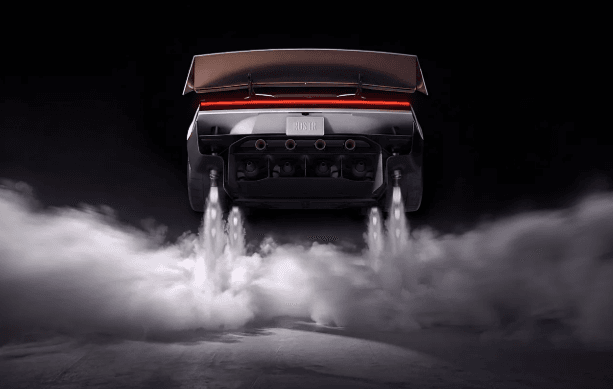
Tesla has finally shown the Roadster that Elon Musk has been talking about for years — and this time, calling it a “flying car” isn’t completely marketing hype.
During Tesla’s October 2026 Roadster reveal, the car used high-pressure thrusters to leave the ground, rotate in the air and land again. Tesla now officially describes the top Rocket version as “flight capable,” although there is a major catch: this is not a normal road car that you will simply drive to work and then fly over traffic. Reuters
And after watching what Tesla demonstrated, I think that distinction matters.
What Did Tesla Actually Reveal?
Tesla unveiled the next-generation Roadster on October 15 at a SpaceX facility in Texas after years of delays.
The demonstration was very different from a normal sports-car launch.
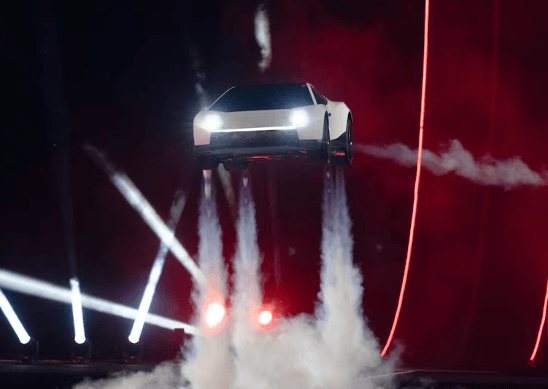
The Roadster accelerated aggressively, used a curved structure to drive upside down, launched into the air and rotated before landing back on its wheels. Reuters reports that the car can also use its thruster system to change direction while airborne. Reuters
So yes, Tesla did show a Roadster leaving the ground.
But when I hear the words flying car, I normally imagine something that takes off, travels through the air for several kilometres and lands somewhere else.
That is not what Tesla demonstrated.
What we saw was closer to an extremely advanced rocket-assisted jump with directional control.
That is still impressive. It is just important not to confuse it with an electric aircraft.
So, Can the Tesla Roadster Really Fly?
The answer depends on which Roadster you mean.
Tesla currently lists three configurations:
- Performance
- Thrust
- Rocket
The standard Performance version is a road-focused two-seat sports car.
The Thrust version adds cold-gas thrusters at the rear and is designed for extreme acceleration.
The Rocket version goes much further. Tesla says it uses cold-gas thrusters positioned around the car to provide forward, upward and rotational thrust.
Tesla’s own German website is unusually direct about it:
“Also ja, er kann fliegen.”
Or in English: “So yes, it can fly.” Tesla
However, Tesla also labels the Rocket version as a one-seat vehicle that is not road legal.
That immediately tells me this is not being positioned as a normal production Tesla for everyday driving.
Read also about Android Auto
How Does the Tesla Flying Roadster Work?
The most interesting part is that it doesn’t use wings or helicopter rotors.
Instead, Tesla is borrowing technology and engineering ideas from SpaceX.
The Rocket Roadster uses cold-gas thrusters.
These thrusters release highly pressurized gas through nozzles to produce force.
Tesla says the system uses electrically controlled actuators to make extremely fast adjustments while the vehicle is in the air. Tesla
In simple terms, imagine several very powerful jets of compressed gas positioned around the car.
By changing which thrusters fire and how strongly they fire, the Roadster can generate force in different directions.
That allows it to:
- push forward
- push upward
- stabilize itself
- rotate
- correct its orientation while airborne
This is very different from a conventional flying car that relies on propellers or wings.
It Also Uses a Suction System
The thrusters aren’t Tesla’s only unusual technology.
The new Roadster also uses active aerodynamics and a powerful multi-mode suction system.
Tesla says powered fans and active wings can produce significant downforce even when the vehicle is barely moving. Tesla
Normally, a sports car needs speed before its aerodynamic surfaces create large amounts of downforce.
Tesla is trying to create that grip independently of speed.
That explains one of the strangest parts of the demonstration: the Roadster travelling upside down along a curved structure before launching into the air.
According to Reuters, Tesla used this suction technology as part of the upside-down demonstration. Reuters
How Fast Is the New Tesla Roadster?
This is where the numbers become almost ridiculous.
Reuters reports that Tesla is targeting 0–60 mph in under one second for the thruster-equipped Roadster. Reuters
During the reveal, Tesla reportedly demonstrated a run of approximately 0.81 seconds to 60 mph. People.com
If those numbers carry into customer vehicles, this would put the Roadster far beyond normal supercar acceleration.
For comparison, anything below two seconds to 60 mph is already considered extreme.
Going below one second changes the problem entirely because Tesla isn’t relying only on tyre grip anymore.
The thrusters can generate additional forward force.
Check also : TESLA BUILT A CAR THAT CAN FLY — BUT WHY?
Is It Actually Useful?
This is where I become more sceptical.
From an engineering perspective, the Roadster is fascinating.
From a practical perspective, I’m not sure flying is really the point.
The Rocket version will sacrifice one of the Roadster’s seats and Tesla says it will not be legal for public-road use. Availability will also depend on regional laws. Tesla
And even if the car can jump or remain airborne briefly, that doesn’t suddenly mean owners will be flying from Berlin to Munich.
There are major questions involving:
- safety
- noise
- airspace regulations
- insurance
- driver training
- infrastructure
- maintenance
- public-road legality
This is why I would not describe the Roadster as the beginning of everyday flying cars — at least not yet.
Then Why Did Tesla Build It?
This may actually be the more interesting question.
Elon Musk himself has acknowledged that the Roadster is unlikely to have a major financial impact on Tesla.
Reuters describes it more as a halo car — a vehicle designed to demonstrate what the company can technically achieve rather than become a huge-volume product. Reuters
And that makes sense to me.
Tesla already has mass-market EVs.
The Roadster doesn’t need to replace the Model 3.
Its job is different.
It gives Tesla something outrageous enough to demonstrate its engineering capabilities while connecting Tesla much more visibly with SpaceX technology.
Essentially, Tesla is saying:
What happens if we combine an electric supercar with rocket engineering?
The Roadster is the answer.
When Can You Buy the New Roadster?
This is another area where I would be cautious.
Tesla has delayed the second-generation Roadster multiple times since it was first announced.
After the 2026 reveal, Tesla is now targeting production in 2028, according to Reuters. Reuters
Tesla’s website currently lists reservation options for the Roadster, while the extreme Rocket configuration is described as invite-only. Tesla
So even if Tesla reaches its current production target, the version capable of the most extreme flight-like behaviour probably won’t be something that anybody can simply order online.
Is This the World’s First Flying Car?
I wouldn’t use that claim without qualification.
Elon Musk has described the Roadster as a flying car, and Tesla officially says the Rocket model can fly.
But there have already been experimental vehicles, roadable aircraft and electric vertical-takeoff projects designed around combining driving and flight.
The Roadster is unusual because it approaches the problem from the opposite direction.
It is fundamentally a high-performance electric car first, and Tesla is adding rocket-style thrust to make it airborne.
That’s very different from designing a small aircraft that happens to have wheels.
Check also : What Is ChatGPT Intelligent UI? I Explain How the New ChatGPT Interface Works
My Take
I think calling the Roadster a “flying car” is simultaneously correct and misleading.
Technically, Tesla has demonstrated a car leaving the ground under its own thrust and controlling itself in the air.
That deserves attention.
But it isn’t the Jetsons.
You’re not going to take off from your driveway and fly across Germany.
At least not with this Roadster.
What Tesla has created is closer to a rocket-assisted hypercar that can perform manoeuvres no conventional production car can currently match.
And to me, that’s actually more interesting than pretending it is an ordinary flying vehicle.
Tesla hasn’t solved flying transportation.
It has taken the idea of a sports car and pushed it into territory that previously looked more like science fiction.
Bottom Line
Tesla’s new Roadster really can leave the ground.
The extreme Rocket version uses SpaceX-inspired cold-gas thrusters positioned around the vehicle to generate upward, forward and rotational force, while a powerful fan-based suction system provides extraordinary downforce. Tesla officially calls that version flight-capable, but it is a single-seat, invite-only vehicle that is not approved for normal public-road use. Tesla
Production of the new Roadster is currently targeted for 2028, and given the model’s history of delays, I would treat that date as a target rather than a guarantee. Reuters
So yes — Tesla built a car that can fly.
But the more accurate question is no longer “Can it fly?”
It is:
“What can Tesla actually do with this technology next?”
Sources
Tesla’s official Roadster page contains the clearest technical breakdown of the Performance, Thrust and Rocket versions. Tesla
Reuters independently covered the October 15 demonstration, specifications and current 2028 production target. Reuters
The Los Angeles Times and CBS also covered the flight demonstration and the Roadster’s unusual capabilities.


Pingback: What Is ChatGPT Intelligent UI? How It Works and How to Turn It Off