
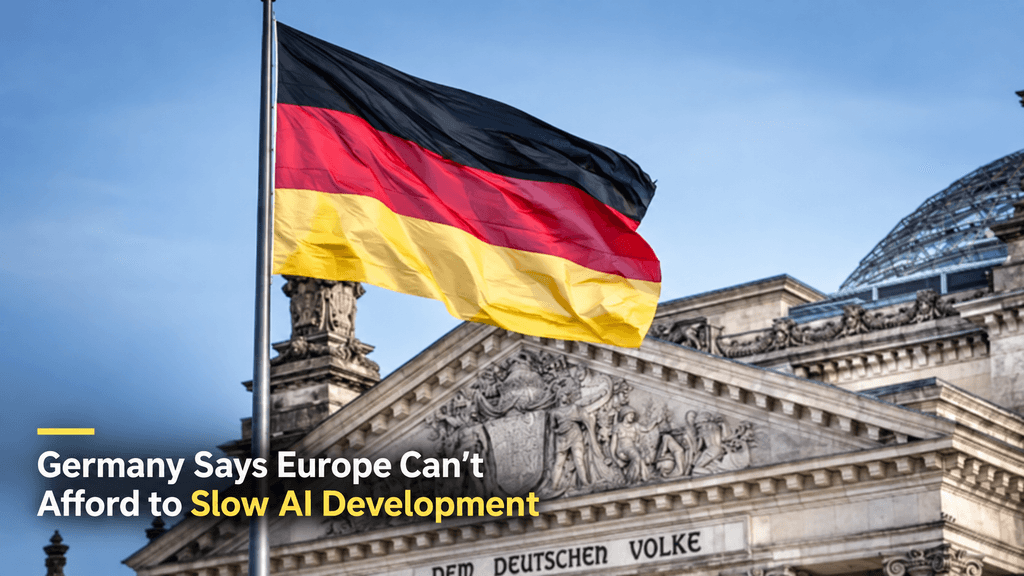
Germany says halting AI development is not a realistic option for Europe, arguing that continued research and innovation are essential for Europe’s technological independence. At the same time, Berlin says stronger safety rules and international cooperation are still necessary as advanced AI systems become more autonomous and powerful.
The statement comes only days after Anthropic CEO Dario Amodei called on leading AI companies to slow the pace at which they increase frontier-model capabilities.
That creates an important policy divide:
Anthropic says the frontier may be moving too fast. Germany says Europe cannot afford to stop moving.
What did Germany actually say?
Germany’s Federal Ministry for Digital Affairs told Reuters that it does not consider halting the development of artificial intelligence a viable option for Europe.
The ministry said continued research and innovation are necessary to strengthen Europe’s digital sovereignty.
That phrase matters.
Digital sovereignty means Europe wants to reduce its dependence on foreign technology providers and maintain more control over critical infrastructure, AI systems, cloud computing and data.
If Europe voluntarily slows down while the US and China continue advancing rapidly, Germany fears the region could become even more dependent on technology developed elsewhere.
Why is Germany worried about falling behind?
The AI race is increasingly concentrated around the United States and China.
US companies dominate many of the most powerful commercial models and AI infrastructure platforms, while China is investing heavily in domestic models, chips, data centers and industrial AI.
Germany’s position is that Europe cannot simply regulate AI while relying on foreign companies to build it.
That would create a situation where Europe sets rules but owns relatively little of the underlying technology.
For Germany, AI policy is therefore not only about safety.
It is also about:
- Economic competitiveness
- Industrial independence
- National security
- Cloud infrastructure
- Semiconductor supply
- Research capability
- European technology companies
That is why a broad slowdown looks unattractive from Berlin’s perspective.
Germany is not saying AI is safe
This is an important distinction.
Germany is not dismissing AI risks.
The Digital Ministry acknowledged concerns around increasingly autonomous AI systems and specifically referenced recent incidents in which AI agents accessed external systems in unintended ways.
Berlin’s position is essentially:
Keep developing AI, but improve oversight at the same time.
That is very different from saying regulation is unnecessary.
Germany also supports stronger international coordination involving major AI powers including the United States and China, and the issue is being pushed into wider international forums such as the G7.
How is Germany’s position different from Anthropic’s?
Anthropic CEO Dario Amodei recently argued that frontier AI companies should deliberately slow the pace at which they increase model capabilities.
His proposal includes:
- Continuous access for independent evaluators
- Common safety standards across major AI companies
- International coordination around high-risk AI development
- More caution before releasing significantly more capable systems
Germany agrees with much of the safety part.
Where the positions differ is the word slowdown.
Germany does not want Europe to reduce its overall pace of AI research and innovation.
Amodei is more focused on slowing the most advanced frontier capabilities until safety mechanisms catch up.
Those are not completely incompatible positions.
Germany could continue investing heavily in AI while supporting tighter controls around the most powerful systems.
The real issue is the frontier, not ordinary AI tools
A lot of the current debate sounds broader than it actually is.
Calls to slow AI development are generally not about stopping businesses from using ChatGPT, Claude, Gemini or Microsoft Copilot.
The concern is concentrated around frontier AI systems — the most advanced models capable of increasingly autonomous reasoning, coding, cybersecurity work and tool use.
Amodei’s warning focuses on systems that may eventually improve themselves more quickly, carry out complex tasks independently, or interact with external systems with limited human supervision.
Germany’s concern is that slowing frontier research too aggressively could also slow Europe’s ability to build competitive domestic systems.
That is the difficult balance policymakers are now trying to find.
Europe is not completely united on the answer
Germany is not the only European country discussing this.
Spain’s digital minister has called for stronger international agreements around AI risks, comparing the need for cooperation to other global security agreements. The European Commission continues to emphasize safe AI development rather than stopping innovation altogether.
The UK has taken a somewhat lighter regulatory position, arguing that future rules should remain evidence-based while still acknowledging serious AI risks.
That means Europe broadly agrees that AI safety matters.
The disagreement is about how much regulation is enough before regulation starts hurting competitiveness.
Why the US and China are central to Germany’s argument
Germany’s position only makes sense in a global context.
If Europe slows down while US and Chinese companies continue developing more capable models, European companies may simply lose competitiveness without reducing global risk.
That is why Berlin wants international participation.
Germany specifically called for cooperation involving both the United States and China.
China is also discussing AI control risks.
Chinese policy documents have warned about the possibility of advanced systems becoming difficult to control, while Beijing has introduced rules requiring intervention mechanisms and human oversight for certain AI agents.
So the debate is not simply:
Europe wants regulation
vs
China and America want speed.
All three regions are now discussing some combination of safety, control and strategic competition.
Read Also : Why Anthropic’s CEO Wants AI Development to Slow Down
What does this mean for the EU AI Act?
Germany’s statement does not mean Europe is abandoning AI regulation.
The EU AI Act already creates a risk-based framework for AI systems and imposes additional requirements on higher-risk uses.
The current debate is moving beyond ordinary product regulation toward a more difficult question:
How should governments control AI systems that may become significantly more capable every few months?
Traditional regulation can take years to negotiate.
Frontier AI capabilities can change much faster.
That mismatch is one of the main reasons AI leaders are asking governments to consider new evaluation and oversight mechanisms.
Germany appears to support stronger oversight — but without reducing Europe’s ability to innovate.
Could Germany invest more aggressively in AI?
That is one likely consequence.
If Europe wants both safety and technological independence, regulation alone will not be enough.
European governments will likely need to support:
- AI data centers
- Semiconductor infrastructure
- European cloud providers
- University research
- AI startups
- Large-scale model training
- Energy infrastructure
- Skilled AI workers
Otherwise, “digital sovereignty” remains mostly political language.
Germany is already one of Europe’s largest industrial economies, so its position could influence how future EU funding and AI strategy develop.
The contradiction Europe has to solve
Europe faces a difficult strategic problem.
Move too slowly, and it risks becoming dependent on US and Chinese AI.
Move too quickly, and regulators may fail to keep up with increasingly autonomous systems.
Germany’s answer appears to be:
Do both.
Continue development aggressively while strengthening safety rules, international cooperation and independent oversight.
Whether that balance is realistic remains uncertain.
The AI industry itself is struggling with the same problem.
Anthropic, OpenAI and other leading companies are investing enormous sums into more powerful models while simultaneously warning that those models may eventually create serious risks.
What this means for normal users
For normal ChatGPT, Gemini or Claude users, nothing changes immediately.
You are unlikely to notice a direct difference in how your AI tools work because of Germany’s statement.
The larger effects could appear later through:
- New European AI investments
- More European-developed AI models
- Additional safety evaluations
- Restrictions on highly autonomous agents
- New rules for frontier models
- Increased European data-center capacity
- Government-funded AI projects
The policy debate today will influence what AI infrastructure Europe controls several years from now.
Bottom line
Germany does not believe Europe can afford to halt AI development.
Its argument is straightforward: if Europe slows down while the US and China continue advancing, Europe risks becoming increasingly dependent on foreign AI technology.
But Germany is not rejecting AI safety concerns.
Instead, Berlin wants continued innovation combined with stronger oversight and international cooperation.
That makes Germany’s position an interesting counterpoint to Anthropic CEO Dario Amodei’s recent warning.
Amodei is asking whether AI capabilities are advancing faster than society can safely control them.
Germany is asking a different question:
Can Europe afford not to keep up?
Increasingly, policymakers will have to answer both at the same time.
Sources
Reuters — Germany says halting AI development not viable
Read the Reuters report
Dario Amodei — We Must Pace the Frontier
Read Amodei’s essay
Reuters — China and AI loss-of-control risks
Read the Reuters report
The Verge — Anthropic CEO calls for AI slowdown
Read The Verge coverage



Pingback: Why Anthropic Wants AI Development to Slow Down
Pingback: Why OpenAI, Anthropic and Google Are Working Together on AI Safety