Quick Answer
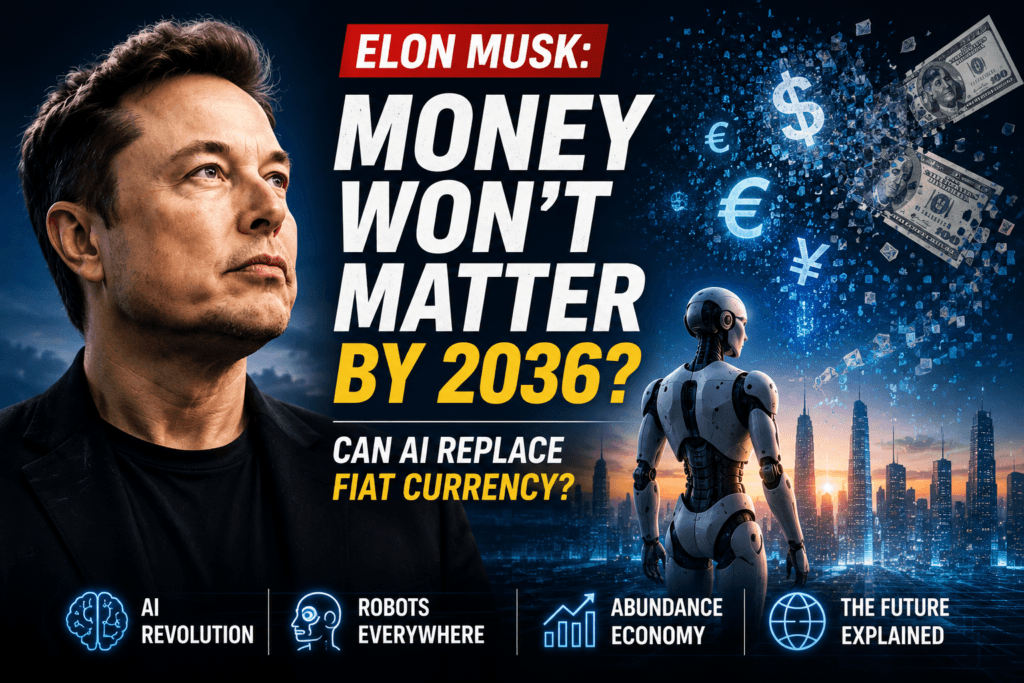
During a recent interview with The Economist, Elon Musk made one of his boldest predictions yet:
“Money won’t matter in 2036.”
The statement quickly spread across social media, with many interpreting it as a prediction that cash and fiat currencies would disappear within the next decade.
However, that’s not exactly what Musk meant.
His argument is that artificial intelligence and humanoid robots could create such an enormous abundance of goods and services that money would become far less important than it is today. Whether that vision becomes reality is another question entirely.
What Elon Musk Actually Said
Speaking with The Economist editor-in-chief Zanny Minton Beddoes, Musk explained that AI is advancing rapidly in the digital world. He believes the next major step is combining advanced AI with millions—possibly billions—of humanoid robots capable of performing physical work.
According to Musk, this would create what he called a “quasi-infinite economy.” If robots can produce nearly everything humans need, scarcity would shrink dramatically.
That is when he made his headline prediction:
“Money won’t matter in 2036.”
The interviewer immediately challenged the idea, pointing out that investors still expect companies like Tesla and SpaceX to make money.
Why Musk Thinks Money Could Become Less Important
Musk’s argument follows a simple chain of reasoning:
- AI becomes smarter than humans in many tasks.
- Humanoid robots perform most physical labour.
- Production costs fall dramatically.
- Goods and services become extremely cheap.
- Society enters an age of abundance.
In that world, people would no longer need large amounts of money to access everyday necessities because machines could produce them at minimal cost.
Does This Mean Fiat Currency Will Disappear?
Not necessarily.
Musk did not say governments will abolish the euro, US dollar, or other fiat currencies.
Instead, he suggested that money itself could lose much of its economic importance if AI makes production almost limitless.
There is an important difference between:
- Money disappearing
- Money becoming less necessary
These are very different scenarios.
Why Many Economists Disagree
Economists generally argue that even an AI-powered world will still face scarcity.
Examples include:
- Land
- Natural resources
- Energy
- Housing
- Rare metals
- Water
- Premium services
Even if robots manufacture products almost for free, these resources cannot simply become unlimited overnight.
Money also performs functions beyond buying products:
- storing wealth
- measuring value
- paying taxes
- investing
- allocating scarce resources
For these reasons, many experts believe a completely “money-free” economy by 2036 is highly unlikely.
Read also : Google AI Search Agents: What Can They Do?
Could AI Really Create an Economy of Abundance?
Artificial intelligence is already reducing the cost of:
- software development
- customer support
- content creation
- manufacturing optimisation
- scientific research
If AI continues improving alongside robotics, the cost of producing many goods could continue falling.
This could lead to:
- cheaper products
- lower production costs
- higher productivity
- greater economic output
However, abundance in some sectors does not automatically eliminate scarcity everywhere.
What Could Happen by 2036?
Several scenarios are possible.
Scenario 1: AI Boosts Productivity
The most likely outcome is that AI makes businesses significantly more productive while money remains central to the global economy.
Scenario 2: Much Cheaper Goods
Robotics could reduce the cost of manufacturing many everyday products, increasing living standards without replacing money entirely.
Scenario 3: Musk’s Vision
In the most optimistic scenario, AI and robotics produce so much that most basic needs become inexpensive or effectively free, making money far less important than it is today.
Whether humanity reaches this point by 2036 remains highly uncertain.
Final Verdict
Elon Musk’s statement was not a prediction that fiat currencies will disappear in ten years.
Instead, he argued that AI and robotics could create such extraordinary abundance that money becomes much less relevant.
It is an ambitious vision, and one that fits Musk’s long-standing belief that AI and automation will fundamentally reshape civilisation.
Whether history proves him right remains to be seen.
For now, the idea should be viewed as a thought-provoking prediction rather than an accepted economic forecast.
Frequently Asked Questions
Did Elon Musk really say money won’t matter in 2036?
Yes. During an interview with The Economist, Musk stated, “Money won’t matter in 2036,” while discussing the future impact of AI and robotics.
Does Musk believe fiat currencies will disappear?
No. His argument is broader: if AI creates an economy of abundance, the role of money could diminish significantly rather than governments simply eliminating fiat currencies.
Is this likely to happen?
Most economists believe AI will transform productivity, but a completely post-money society by 2036 remains speculative and is not the mainstream economic view.